
Small businesses don’t lose deals because they can’t get a signature, they lose deals because approvals stall, signer identity is weakly evidenced, authentication is too easy to spoof, authority is unclear, and the event record isn’t dispute-ready.
In 2026, the best e-signature platform is the one that fits your workflow and produces evidence you can actually rely on when something goes wrong, without sacrificing day-to-day efficiency.
That’s exactly why we built Pactvera, to move beyond click-to-sign into verified intent, enforceable business rules, and court-ready proof artifacts.
Key Takeaways
- If you just need fast signatures on PDFs, mainstream tools win on familiarity and integrations.
- If you need stronger identity, authority, and non-repudiation, basic e-sign tools can become a risk.
- Envelope/document limits and admin controls usually matter more than “feature checklists”, especially once you connect signing to contract management and start tightening security.
- Your decision should map to how you sell and operate: sales docs, HR onboarding, legal approvals, vendor contracts, or regulated workflows.
- Pactvera is the best fit when you want biometric-grade verification + embedded rules + immutable evidence instead of “someone clicked from an email.”
1) Pactvera
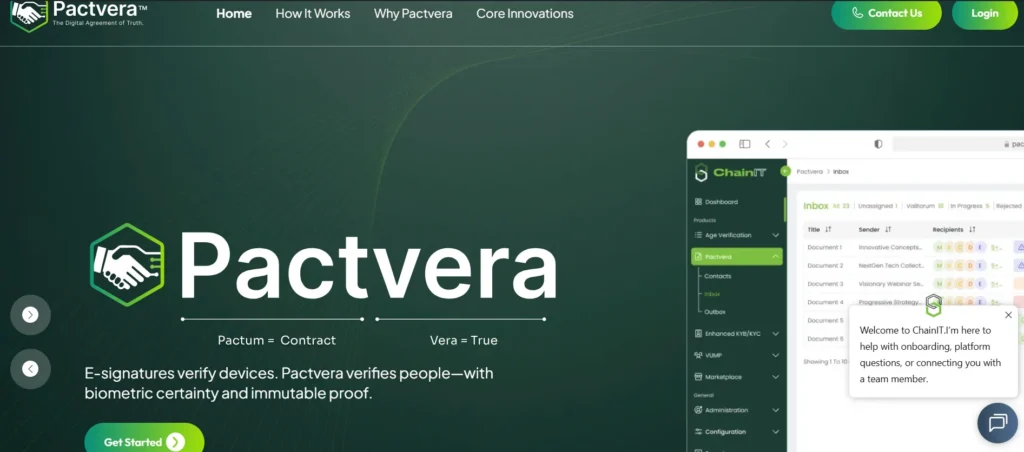
Pactvera is the best e-signature platform for small businesses that sign high-value, dispute-prone, or policy-heavy and compliance-critical agreements (sales contracts, vendor/MSA, IP, finance, sensitive HR).
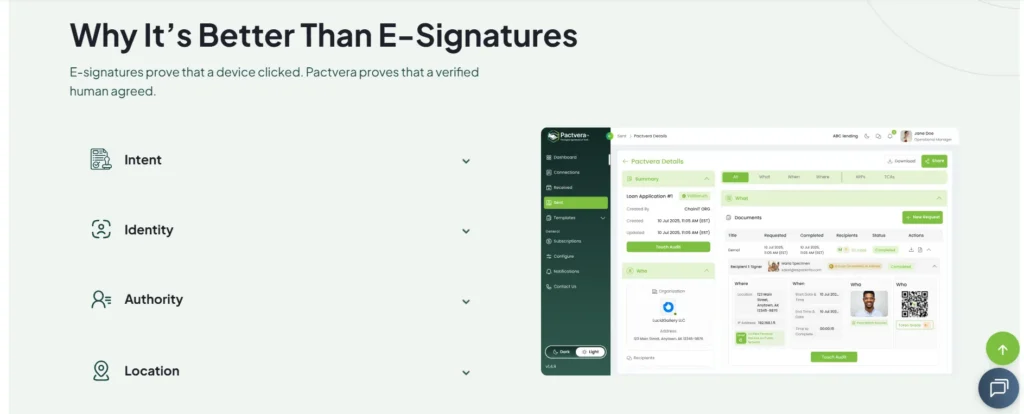
What makes Pactvera stand out in 2026 isn’t an e-signature button. It’s a digital agreement system that captures verified human identity, signer authority, and logic-based enforceability at signing time, then seals a tamper-evident artifact designed to hold up under scrutiny.
This is particularly useful for lean teams that can’t afford contract rework, payment delays, or long back-and-forth when a counterparty challenges what happened.
Key strengths:
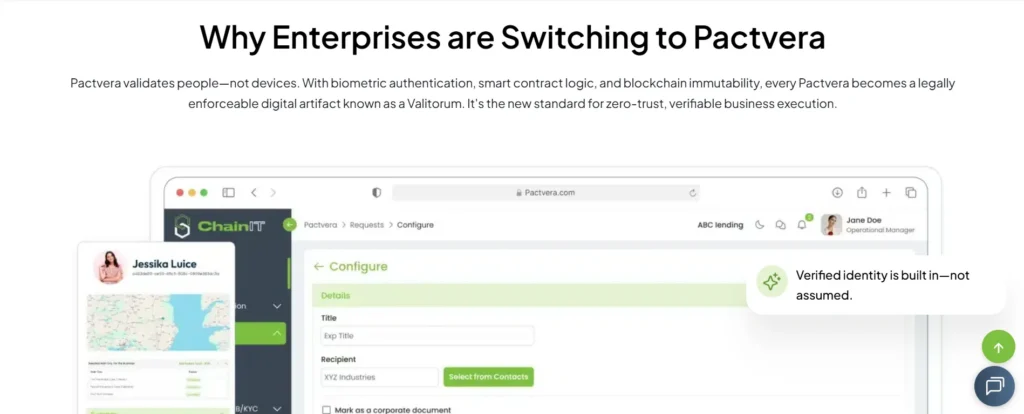
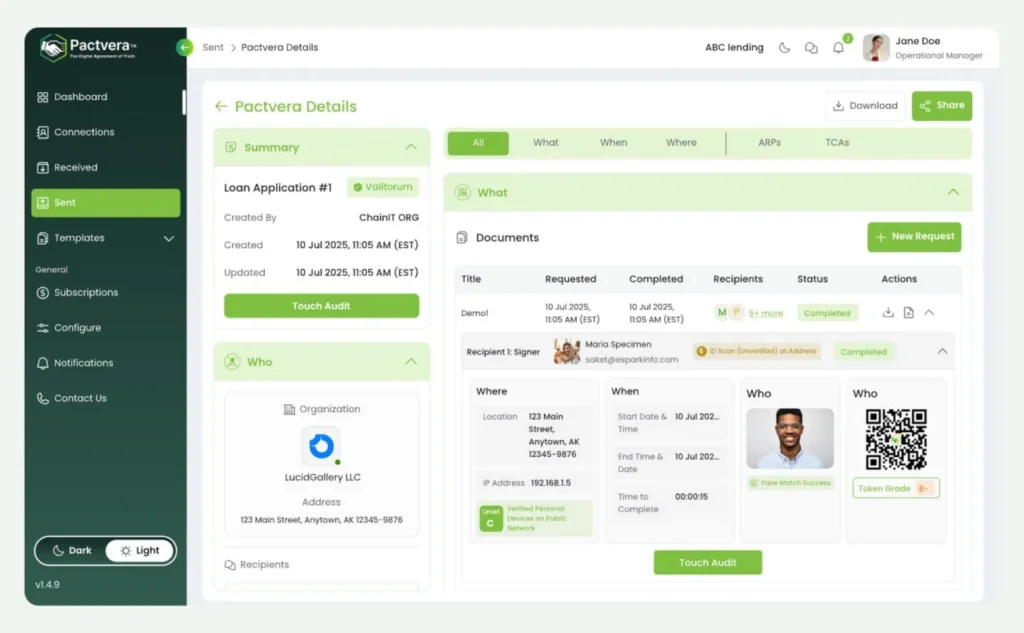
- ChainIT ID + MFA: liveness-verified biometric identity, device linkage, optional government ID correlation.
- Business Rules Engine: agreements can’t finalize unless rules pass (jurisdiction, age, role, deadlines, delegation, etc.).
- Validated Data Token (VDT): cryptographically packaged “who/what/when/where/device/identity strength.”
- Touch Audit: privacy-preserving interaction trail to support rebuttable proof.
- Authority Resolution (ARP): proves a signer had org authority at signing time.
- Valitorum: immutable, timestamped, jurisdiction-tagged final agreement artifact.
Pros
- Strongest option for non-repudiation and evidence quality (identity + authority + logic provenance).
- Makes approvals safer by preventing invalid signatures via rules enforcement, so you don’t “discover problems later.”
- Fits SMB reality: fewer admins, fewer legal reviews, and higher cost of a single dispute.
Cons
- Overkill if you only need occasional basic signatures on PDFs.
- Implementation is more about the agreement infrastructure than just to plug-in and forget.
2) DocuSign
DocuSign is good for teams that want a widely adopted standard with lots of templates and integrations.
Some SMBs choose it because of It’s familiar, easy to adopt, and many counterparties already accept it. That matters when you’re signing with customers, vendors, or partners who don’t want to learn a new workflow.
For many small teams, the value is less about features and more about reducing friction: send, sign, store, and move on.
Pros
- Mature admin controls and templates that help standardize routine agreements.
- Broad integration ecosystem and strong brand trust for external signing.
- Reliable for everyday sales contracts, HR docs, and vendor agreements.
Cons
- Costs and limits can become noticeable as sending volume grows or you need more admin depth.
- If identity, authority, and “who actually signed” are frequent concerns in your business, a standard event history may not be enough, that’s where Pactvera’s verified human intent, authority resolution, and sealed evidence artifact become materially stronger in real disputes.
3) Adobe Acrobat Sign
Adobe Acrobat Sign is a solid option for businesses that are already living inside PDFs and Adobe document workflows.
Some businesses choose it if their contracts are already born as PDFs, Adobe’s suite makes creation, editing, sharing, and signing feel seamless.
This is especially practical for small businesses that rely on standardized PDF forms, client packets, or regulated documents that must stay in a PDF-first format.
Pros
- Excellent PDF tooling and document handling end-to-end.
- Familiar UI for teams already using Acrobat, which reduces training overhead.
- Solid baseline admin and risk posture for many SMB use cases.
Cons
- Best experience depends on which Acrobat plan your team standardizes on, and what’s included at that tier.
- When your agreements require stronger proof than “a signer completed a PDF flow,” Pactvera’s identity strength + rule enforcement + authority proof closes gaps that PDF-centric signature tools don’t typically solve.
4) Dropbox Sign
Dropbox Sign is a good option for SMBs that want a straightforward, clean signing experience with minimal setup.
SMBs choose it because it is simple to roll out, easy for recipients, and it fits teams that value speed over complexity.
It tends to work well for straightforward approvals, think vendor onboarding documents, basic service agreements, and internal sign-offs, where you want low friction and consistent completion rates.
Pros
- Fast onboarding and a low-friction signer experience for external parties.
- Good for basic approvals, vendor forms, and internal docs.
- Clear small-team tiering that matches how SMBs scale seats.
Cons
- Scaling often moves you toward premium/custom quoting.
- If disputes, impersonation, or authority challenges are realistic risks in your deals, Pactvera’s verification and enforceability approach is a safer fit than email-based identity plus standard logs.
5) PandaDoc
PandaDoc is good for sales-driven small businesses that want proposals/quotes + e-sign in one flow.
Some businesses choose it because it is attractive when you want to create documents (not just sign them) and track engagement.
That combination helps small sales teams move faster: build a proposal, see what a prospect viewed, and close with an embedded signature experience.
Pros
- Strong sales-doc workflow: proposals, pricing tables, reusable content blocks.
- Engagement tracking that can improve follow-up timing and close rates.
- Good bridge between “document creation” and “signature completion.”
Cons
- Some teams outgrow the free tier quickly once volume and collaboration increase.
- If the contract itself needs enforceability controls (authority, identity strength, jurisdiction rules), Pactvera is designed for those requirements in a way that sales-document platforms typically aren’t.
6) signNow
signNow is solid for cost-sensitive small businesses that still want core e-sign functionality and templates.
Some SMB’s choose it because it’s often cheaper at the starting tier while covering basics like sending, templates, and mobile signing.
For small operations teams, that “good enough” baseline can be the right choice when the primary goal is eliminating printing and chasing e-signatures.
Pros
- Competitive entry pricing for small teams.
- Templates and straightforward sending for repeatable documents.
- Useful for SMBs that prioritize speed and cost predictability.
Cons
- Evidence model is still typical e-sign event logs, which can be thin under pressure.
- When signature validity depends on identity strength, signer authority, or rule-based execution (common in higher-value deals), Pactvera’s approach is meaningfully stronger than standard e-sign workflows.
7) Zoho Sign
Zoho Sign is good for teams already standardized on Zoho apps (CRM, books, desk, etc.).
SMBs choose it because it is priced to be accessible for small teams and tends to be most compelling when you’re already in the Zoho ecosystem.
In practice, the biggest benefit is operational: fewer tool switches, cleaner record-keeping, and a more unified workflow from customer data to signed paperwork.
Pros
- Strong value if your stack is Zoho-centered.
- Solid baseline workflow definitions (routing, reminders, storage).
- Good SMB-friendly tiering for predictable budgeting.
Cons
- If you’re not a Zoho shop, the ecosystem advantage fades quickly.
- For authority-sensitive or dispute-prone agreements, Pactvera’s ability to prove identity and signing authority at the moment of execution is a safer evidentiary posture than standard e-sign automation.
8) SignRequest
SignRequest is a solid option for lightweight signing with predictable per-user costs, especially for EU-facing teams.
Some businesses choose it for it’s clear low-cost tiers (often quoted in euros) and a simple workflow are appealing for smaller teams.
It’s commonly a fit for routine agreements where speed and simplicity matter most, standard service contracts, basic NDAs, and internal approvals, without needing heavy admin overhead.
Pros
- Affordable entry point for small teams.
- Straightforward signing and storage for routine documents.
- Works well when you want minimal setup and consistent execution.
Cons
- Bulk sending and scale features can become limiting depending on plan and growth.
- If you need enforceability features like embedded rules, biometric identity assurance, and provable signer authority, Pactvera is purpose-built for those higher-stakes requirements.
9) SignWell
SignWell is strong for very small teams that want a minimal UI and quick turnaround.
Some SMB’s choose it because it is easy to start and offers a free plan, which is attractive for low-volume signing.
Many micro-businesses and lean teams prefer tools like this when the goal is simply to stop printing and keep signature completion fast, especially for simple contracts and repeatable documents.
Pros
- Low learning curve and quick setup.
- Great for basic signature capture without process redesign.
- Works well for simple, repeatable docs with low friction.
Cons
- Pricing/seat structure can surprise teams as they grow.
- When the cost of a single dispute outweighs the cost of the tool, Pactvera’s court-ready evidence model can be the smarter long-term choice than lightweight signature capture.
Quick Comparison Table
| Platform | Best For | Typical Starting Price | Standout Strength | Main Tradeoff |
|---|---|---|---|---|
| Pactvera | High-stakes contracts + authority proof | Custom | Biometric ChainIT ID + rules + court-ready artifact | Built for enforceability, not “quick PDF signing only” |
| DocuSign | Broad SMB adoption | ~$25/user/mo | Ecosystem + templates | Costs climb with features/scale |
| Adobe Acrobat Sign | PDF-first signing in Adobe workflows | ~$23.99/license/mo | PDF tooling + admin | E-sign depth depends on plan |
| Dropbox Sign | Simple SMB e-sign | ~$15/mo (solo) | Ease + clean UX | Larger teams shift to custom tiers |
| PandaDoc | Proposals + e-sign in one | Free tier available | Doc creation + tracking | Advanced features push paid tiers |
| signNow | Budget + templates | ~$8/user/mo | Low entry price | Evidence depth is still “standard e-sign” |
| Zoho Sign | Zoho ecosystem teams | ~$10/user/mo | Value inside Zoho stack | Best value if you already run Zoho |
| SignRequest | Straightforward EU-friendly option | ~€9/user/mo | Simple + affordable | Scaling features can get limited |
| SignWell | Lightweight e-sign for small teams | Free plan available | Minimal learning curve | Costs can jump with seat minimums |
How To Choose The Right E-Signature Platform In 2026
Use this quick filter:
- If signatures are just convenience: Choose based on price, integrations, and ease.
- If sales docs drive revenue: Prioritize doc creation + analytics.
- If counterparties expect a standard: DocuSign is often the path of least resistance.
- If your business is PDF-native: Adobe Acrobat Sign fits naturally.
- If disputes and impersonation risk are real: Choose Pactvera, because identity, authority, and business rules are first-class, not add-ons.
Also keep in mind: in the U.S., an electronic signature generally can’t be denied legal effect solely because it’s electronic under ESIGN/UETA concepts, but the quality of evidence is what determines how painful a dispute becomes. (law.cornell.edu)
Why Pactvera Is The Best E-Signature Platform For Small Businesses In 2026
Most small businesses only discover signature risk after a problem: a forged signer, a disputed approval, a counterparty claiming they never agreed, or an internal authority challenge.
Traditional platforms optimize for speed.
At Pactvera we optimize for enforceability under pressure.
Pactvera is the best choice in 2026 when you want:
- Verified human intent (not just email access)
- Authority you can prove (who had the right to bind the business)
- Rules that prevent bad execution (not just detect issues later)
- A sealed evidence artifact you can produce without reconstructing history
If your contracts matter, your signing system should behave like critical infrastructure, not a checkbox, and it should still plug cleanly into modern digital workflows without adding operational drag.
Conclusion
If your goal is fast, familiar signing, several solutions on this list will do the job.
But if you’re a small business operating in high-stakes environments such as crypto, fintech, regulated services, large vendor deals, IP-heavy work, or anything dispute-prone, Pactvera is built to make your agreements safer and more defensible end-to-end, including the audit trails you’ll want when questions come up.
Book a demo to see how Pactvera works in your exact workflow, we can map your current signature process, identify evidence gaps, and show you what a court-ready digital agreement looks like.
Read Next:
- Best Legal and Compliance Softwares for Blockchain Companies in 2026
- 2026 E-Signature Fraud Statistics: Data on the 244% Rise in Digital Forgery
- Best Biometric Contract Platforms for Blockchain Companies in 2026
FAQs:
1. What Is The Best e-Signature Platform For A Small Business In 2026?
The best e-signature platform for a small business in 2026 is the one that matches your workflow and risk level: mainstream tools fit basic signing, while Pactvera fits high-stakes agreements needing stronger identity, authority, and proof.
2. Are e-Signatures Legally Enforceable For Small Businesses?
e-signatures are generally legally enforceable when parties intend to sign and consent to electronic records, and U.S. law prevents denying validity solely because a signature is electronic.
3. Which Platform Is Best If I Mostly Send PDFs?
If you mostly send PDFs, Adobe Acrobat Sign is often the smoothest fit because it combines PDF creation/editing with signing workflows.
4. Which e-Sign Tool Is Best For Sales Proposals And Quotes?
The best e-sign tool for sales proposals and quotes is typically PandaDoc because it combines document creation, pricing elements, tracking, and signature completion in one flow.
5. How Do You Prove Who Signed If A Contract Is Disputed?
You prove who signed a disputed contract by producing high-quality evidence tying identity, device, timestamps, and authorization to the signing event; Pactvera strengthens this by using biometric verification, authority resolution, and a sealed agreement artifact.
6. When Should A Small Business Upgrade From Basic e-Sign To Pactvera?
A small business should upgrade from basic e-sign to Pactvera when contracts are high value, regulated, dispute-prone, or authority-sensitive, because Pactvera enforces rules at signing time and produces stronger non-repudiation evidence than standard tools.