
Digital contract disputes rarely turn on whether a document exists. They turn on whether a specific person actually assented, whether they had authority, and whether the record you present is reliable enough for a judge, regulator, or opposing counsel to trust.
If your proof is just a completed status and a PDF, you are inviting the classic defense: “I did not sign that“.
Key Takeaways
- To prove who signed, you must establish attribution, intent, authority, and integrity in a way a third party can validate.
- The strongest proof links a real human to the signing act, not just an email address or a device click.
- Audit logs are useful, but courts prefer tamper-evident, complete evidence packages with clear chain-of-custody.
- Pactvera is designed for dispute-proof contracting with ChainIT ID + MFA, a Business Rules Engine, Validated Data Tokens, Touch Audit™, authority resolution, and the Valitorum sealed artifact.
What Do You Need to Prove in Court?
To prove who actually signed a digital contract in court, you need evidence that answers four questions clearly and consistently:
- Attribution (Who signed?)
Can the signing event be reliably linked to a specific person, not just an account? - Intent (Did they mean to sign?)
Did the signer knowingly assent to the agreement and its terms through a clear signing process? - Authority (Could they bind the organization?)
If the agreement is corporate, did the signer have the role or delegated authority to commit the entity? - Integrity (Has anything been altered?)
Can you show the contract content and the audit record have not been tampered with since execution?
When these four pillars are strong, the dispute becomes hard to sustain. When any pillar is weak, the other side has room to create doubt.
1. Proving Attribution (Who)
Attribution is the heart of proving who signed.
Courts and regulators are not impressed by a claim that an email address signed. They want to know how you can connect the act of signing to an identified human and demonstrate authenticity under scrutiny.
What Attribution Evidence Looks Like
A strong attribution record typically includes:
- Identity verification signals: Evidence of how identity was verified and how strong that verification was.
- Authentication and access control: Multi-factor authentication, device binding, session controls, and proof that access required more than a single credential.
- Device and session context: Metadata that places the signing event in a coherent technical context, subject to privacy and jurisdictional constraints.
Why Email-Only Attribution Is Weak
Email-based signing is not automatically invalid, but it is easy to challenge because it proves access to an inbox at a moment in time, not the person behind the inbox.
If the dispute is high-stakes, email-only flows often lack the evidence needed to end the argument.
How Pactvera Strengthens Attribution
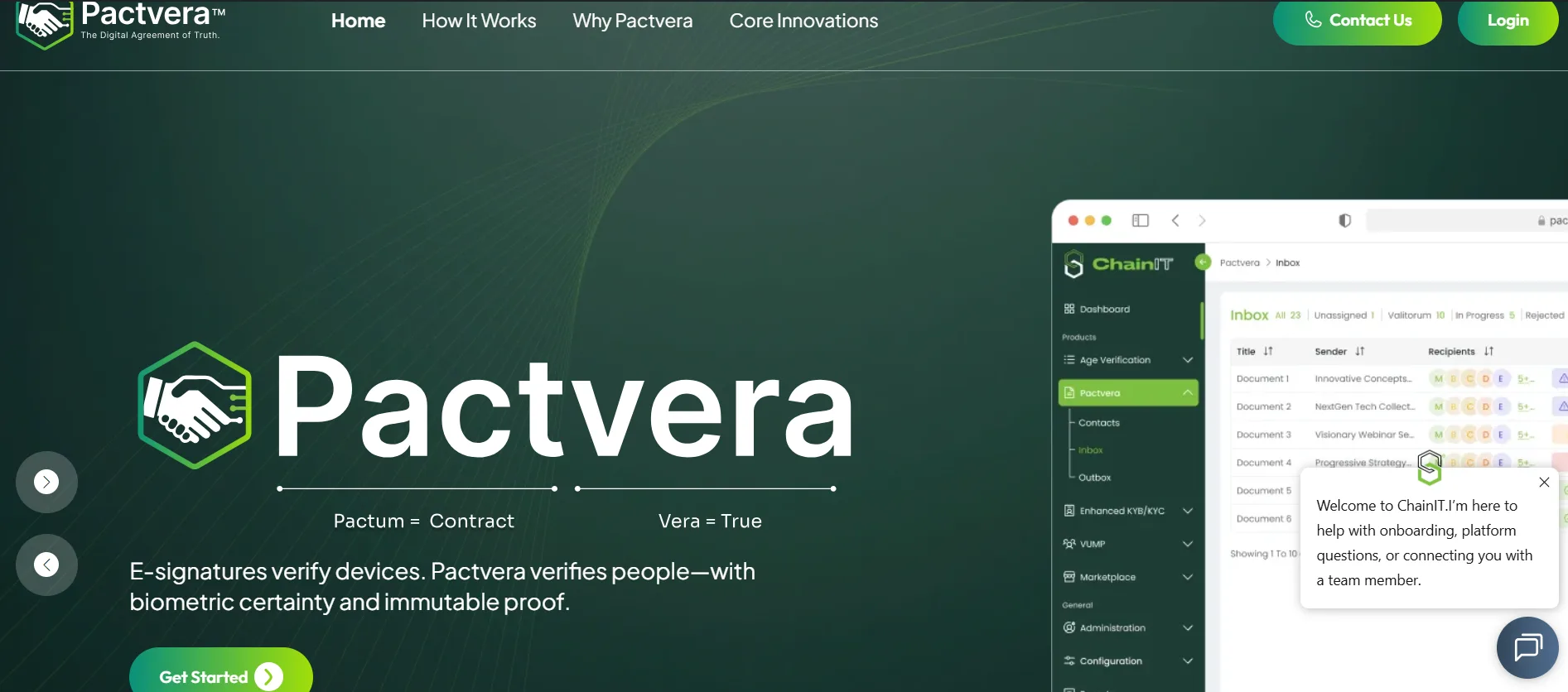
In Pactvera, we replace account-level attribution with human-level proof:
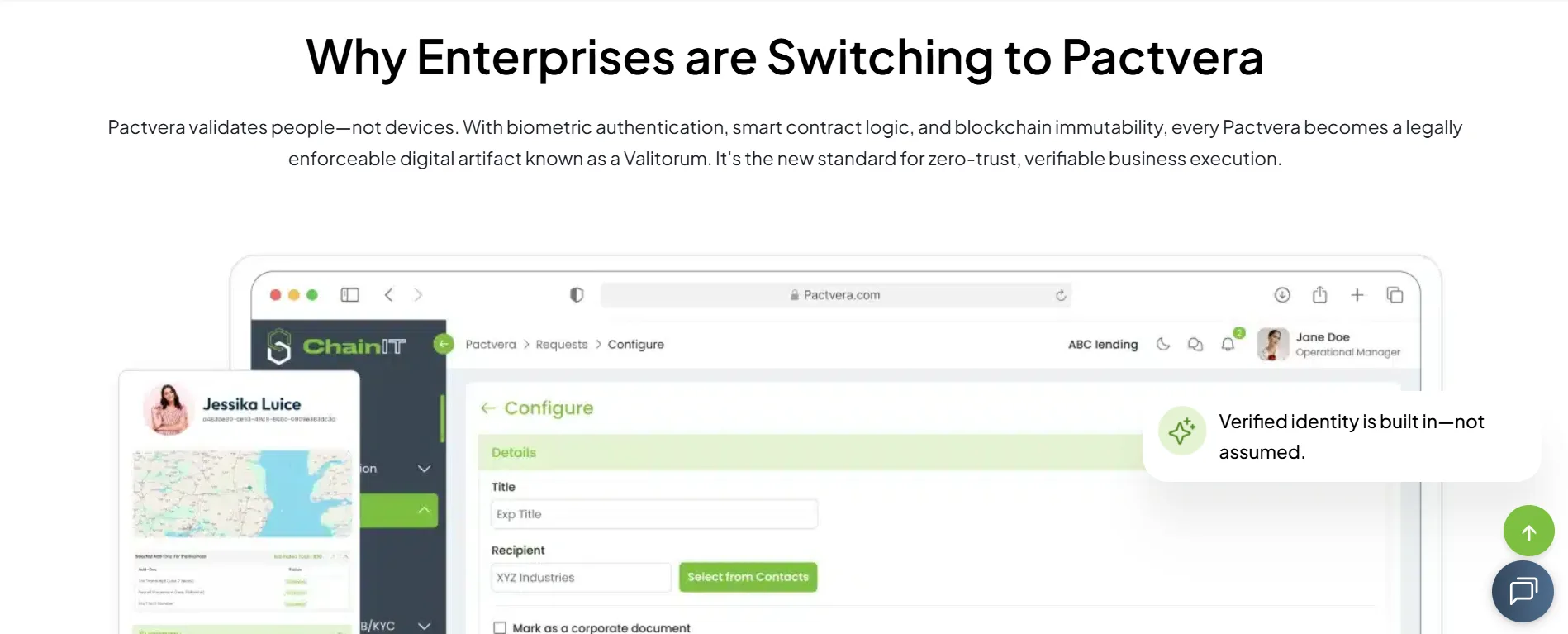
- ChainIT ID with liveness-verified biometrics ties the signing act to a real human presence.
- MFA and device linkage reduce credential sharing and impersonation risk.
- Identity strength signals allow evidence to be presented with clarity, not hand-waving.
This is the difference between a click and a court-ready attribution claim.
2. Proving Intent (Did They Mean to Sign)
Even if you can show a person likely executed the signing action, the dispute may shift to intent.
The signer may claim they did not understand what they were accepting, did not see certain terms, or were misled.
What Courts Want to See for Intent
A strong intent record includes:
- Clear assent capture: The signer was presented with an unambiguous acceptance step, tied to the agreement content.
- Process sequence: Evidence that the signer followed a logical review-to-assent pathway, not a rushed or unclear flow.
- Interaction evidence where appropriate: A defensible trail of what was presented and acknowledged during the signing session, without over-collecting personal data.
How Pactvera Proves Intent
Pactvera’s Touch Audit™ captures a privacy-preserving interaction trail designed to support rebuttable proof. Combined with signing step controls, it provides a stronger narrative for intent: what was shown, what was acknowledged, and when assent was recorded.
3. Proving Authority (Did They Have the Right to Bind the Org)
In B2B disputes, the defense is often not If someone did not sign, but about whether they were authorized to sign.
Authority is separate from identity. A real person can sign and still lack binding authority.
What Authority Proof Should Include
- Organizational identity and linkage: Evidence that the signer is associated with the organization.
- Role or delegated authority: Proof of capacity to bind, whether through role-based permissions, delegation, or documented approval.
- Workflow evidence: When relevant, proof of internal approvals, countersignature logic, or governance steps.
How Pactvera Addresses Authority
Pactvera supports ChainIT Org ID and Authority Resolution to package authority evidence with the signing record.
Instead of assuming the signer was authorized, we aim to make authority demonstrable, reducing one of the most common corporate dispute angles.
4. Proving Integrity (Was Anything Altered)
Integrity is about tamper resistance. Courts care about whether the document and the record you present are the same as the document and record that existed at signing.
Integrity Proof That Holds Up
- Document hashing and sealing: A cryptographic fingerprint of the exact agreement content at signing.
- Immutable timestamping and provenance: A reliable way to show when the signing occurred and that the artifact has not changed.
- Chain-of-custody: Evidence that the agreement artifact and its audit trail have been preserved without gaps.
Why Loose Exports Create Problems
A PDF plus a CSV audit export is better than nothing, but it can be attacked: files can be edited, context can be missing, and the integrity of the export itself can be disputed.
Pactvera’s Integrity Approach
Pactvera produces a sealed artifact called Valitorum, designed to be immutable, timestamped, jurisdiction-tagged, and audit-linked.
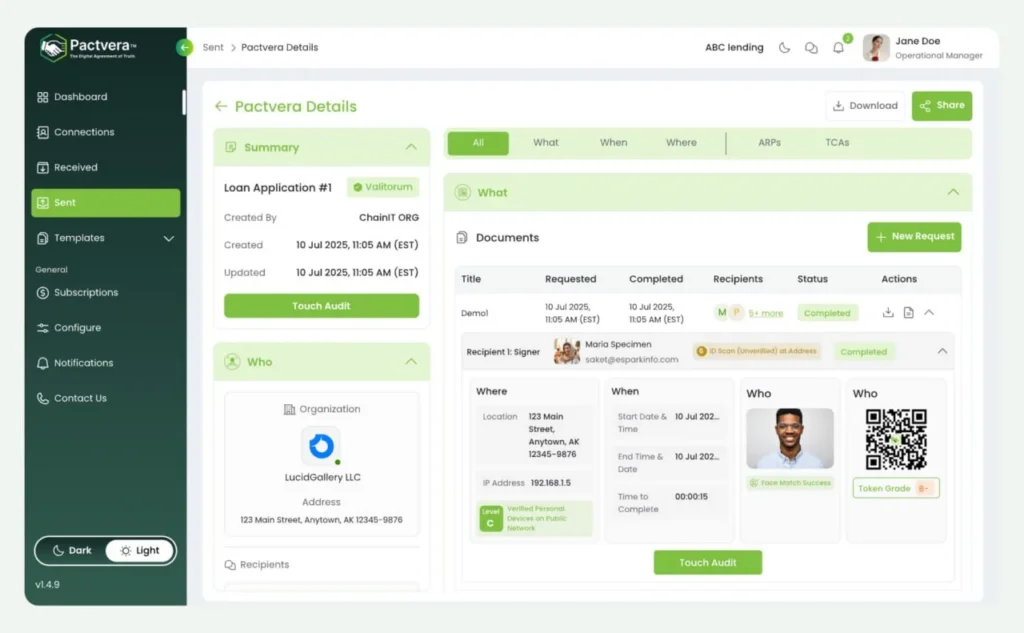
We also generate Validated Data Tokens (VDTs) that capture structured evidence about the signing event, including identity strength and execution context.
The point is not to overwhelm the court with data. The point is to provide a coherent, verifiable package.
The Evidence Stack That Wins Digital Signature Disputes
If you want a practical checklist of what to produce when the question is who signed, this is the evidence stack that tends to matter most and is typically what a lawyer will ask for early in the case:
Court-Oriented Evidence Checklist
- Verified identity method and strength
- MFA and authentication factors used
- Timestamped signing event record
- Session and device continuity signals
- Assent and interaction evidence for intent
- Authority evidence for organizational signers
- Document integrity proof and version lock
- Tamper-evident sealing and chain-of-custody packaging
Pactvera is designed to generate this stack automatically, as a natural byproduct of execution.
What Court-Ready Proof Looks Like in 2026
Court-ready proof is not about collecting everything. It is about collecting the right things, with defensible controls.
Characteristics of Court-Ready Digital Contract Proof
- Human presence verification for high-stakes workflows
- Clear identity binding to the signing act
- Rules that enforce completion prerequisites
- Tamper-evident evidence packaging
- A single, coherent artifact for presentation
- Privacy-aware audit design that aligns with modern compliance expectations
This is also where your framework should align with legal expectations around what constitutes a legally binding record, especially in jurisdictions governed by statutes like UETA and the E-sign Act.
How Pactvera Proves Who Signed, End to End
1. ChainIT ID + MFA: Prove a Real Human, Not Just an Account
Pactvera uses liveness-verified biometrics to link the act of signing to a real person. MFA and device linkage add layered security and reduce common attack paths like credential compromise and shared access.
2. Business Rules Engine: Prevent Weak Execution Paths
Pactvera’s Business Rules Engine enforces rules before an agreement can finalize, such as jurisdiction gating, age requirements, role prerequisites, deadlines, and mandatory sequence controls.
This matters because a process that allows shortcuts often produces evidence that looks incomplete under scrutiny.
3. Validated Data Token: Tokenized, Structured Evidence
A VDT captures who, what, when, where, device context, and identity strength in a structured format that is designed for evidence use, not just internal logging.
4. Touch Audit™: Privacy-Preserving Interaction Trail
Touch Audit records meaningful interaction signals that support intent and rebuttal, without turning contracting into invasive tracking.
5. Authority Resolution: Reduce Corporate Signing Disputes
For enterprise agreements, authority challenges are common. Authority Resolution aims to attach binding authority proof to the signing record, so the dispute does not devolve into informal emails and internal org charts.
6. Valitorum: The Sealed Final Artifact
Valitorum is the final sealed artifact, positioned as court-ready: immutable, timestamped, and linked to the full signing evidence package, including a single exportable digital certificate that can be used to present execution facts clearly.
Conclusion
To prove who actually signed a digital contract in court, you need more than a signature image, a completed status, or an email trail.
You need attribution tied to a real person, clear intent capture, authority proof where relevant, and tamper-evident integrity for both the contract and the audit record.
Pactvera is built specifically for this evidentiary standard, producing a sealed, court-oriented record of identity, process, and proof.
If you want to reduce signature disputes and strengthen enforceability for high-stakes agreements, book a demo with Pactvera and see what court-ready contracting looks like in practice.
Read Next:
- Audit Trails for Digital Contracts: What Courts and Regulators Expect in 2026
- Best Platform for Non-Repudiation in Digital Contracts
- Best e-Signature Software in 2026 with Biometric Authentication
FAQs:
1. How do you prove who signed a digital contract in court?
You prove it by presenting reliable evidence of attribution, intent, authority, and integrity, supported by identity verification, authentication controls, tamper-evident audit trails, and a verifiable signing process.
2. Is an email address enough to prove someone signed a contract?
An email address can support attribution, but on its own it is often weak because emails can be shared, forwarded, or compromised. Stronger proof ties the signing act to verified identity and secure authentication.
3. What evidence is most persuasive in a digital signature dispute?
The most persuasive evidence usually combines high-assurance identity verification, MFA, a timestamped signing record, intent signals from the signing flow, document integrity proofs, and sealed evidence packaging.
4. Why does authority matter when proving a digital contract?
Authority matters when proving a digital contract because a signer can be real and still not be authorized to bind an organization. Authority evidence reduces disputes where the other side claims the agreement is not enforceable due to lack of capacity.
5. How does Pactvera prove signer identity better than standard e-sign tools?
Pactvera is designed to link a real human to the signing act using ChainIT ID with liveness-verified biometrics plus MFA, then package that proof with rules-based execution and tamper-evident evidence artifacts aligned to legality requirements.